Reminder: Click on Over to the New Creative Cat!
Posted: May 10, 2012 Filed under: blogging | Tags: blogging, the creative cat Leave a comment
Jelly Bean and Giuseppe have been keeping some pretty late nights with me!
“Mom’s been really b-o-o-r-r-r-r-i-i-n-n-g-g lately.”
“But we’re really catching up on our sleep.”
“That’s not so bad.”
[zzzzzzzzzzzzzzzzzzz]
So while they’ve been piled up and sleeping all over my desk, while the lilacs have come and gone and the first nestlings are fledging, I’ve finally finished a project I’ve been working on for several months: moving The Creative Cat to a self-hosted site!
Where the heck have I been? Moving! But only electronically—I’ve set up The Creative Cat on a self-hosted site so read all about the new layout.
Most importantly for those of you who subscribe via e-mail, subscribers did not transfer when I moved everything to the new site. Please visit the new site and make sure you sign up for a new e-mail subscription for the new address.
I moved all content there, so all the posts and comments from the very beginning in January 2009 are there and we can continue our conversation as if nothing happened. I won’t be posting here any more, but I will leave this in place for the foreseeable future for both you and I to reference, and because, for now, all those images are still stored in this library for use on the new blog until I transfer them over, one by one…
www.thecreativecat.net See you there!
Click on Over to the New Creative Cat!
Posted: May 6, 2012 Filed under: blogging | Tags: blogging, the creative cat 4 CommentsJelly Bean and Giuseppe have been keeping some pretty late nights with me!
“Mom’s been really b-o-o-r-r-r-r-i-i-n-n-g-g lately.”
“But we’re really catching up on our sleep.”
“That’s not so bad.”
[zzzzzzzzzzzzzzzzzzz]
So while they’ve been piled up and sleeping all over my desk, while the lilacs have come and gone and the first nestlings are fledging, I’ve finally finished a project I’ve been working on for several months: moving The Creative Cat to a self-hosted site!
Where the heck have I been? Moving! But only electronically—I’ve set up The Creative Cat on a self-hosted site so read all about the new layout.
Most importantly for those of you who subscribe via e-mail, subscribers did not transfer when I moved everything to the new site. Please visit the new site and make sure you sign up for a new e-mail subscription for the new address.
I moved all content there, so all the posts and comments from the very beginning in January 2009 are there and we can continue our conversation as if nothing happened. I won’t be posting here any more, but I will leave this in place for the foreseeable future for both you and I to reference, and because, for now, all those images are still stored in this library for use on the new blog until I transfer them over, one by one…
www.thecreativecat.net See you there!
Big and Little
Posted: May 4, 2012 Filed under: black cats, cat behavior, cat photographs, cats, daily photo, giuseppe, mimi, photographs | Tags: black cats, cat photographs, cats, feline photographs, pet photography, photography 4 Comments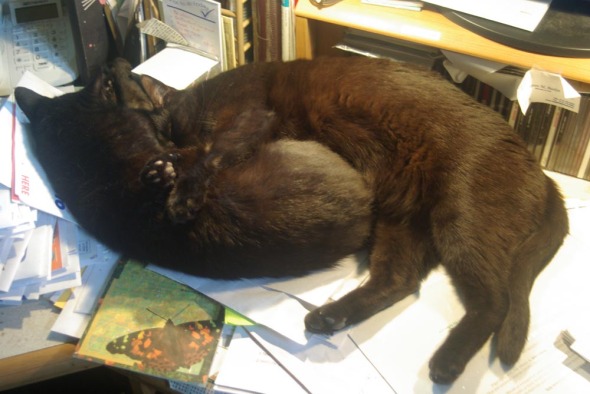
Mimi and Giuseppe cuddle on my desk.
Giuseppe is not so big as Mimi is petite, Giuseppe with a very long body and heavily muscled and Mimi so tiny sometimes I can’t believe how small she is. She weighs a little less than half of his weight, and she is half as long and half as tall, nearly completely half of him. They cuddle together often; Giuseppe loves his Mama Mimi and she enjoys cuddling with her kids and even giving a little touch-up bath.
Here Giuseppe has his head on her arms and at one point he had his arms around her and was holding her as if he was hugging a stuffed toy.
Tell me, could you focus on your work with such distractions? By the end of the day, there was another four-cat cuddle puddle, the only one of the five who was missing was Mewsette, enjoying the bed all to herself.
Perhaps he was dreaming of Mlle. Daisy Emerald Marguerite, his love who lives by the big river in Kingston. He heard that she and her mama had moved to a new apartment, and today he sent her a card. I often notice that Giuseppe spends lots of time with his Mama Mimi when he is longing for his love.
________________________________
Unless I have linked the photo to something else, which is rare with daily photos, you can click the photo to see a larger version. I save them at 1000 pixels maximum dimension, and at that size the photos are nearly twice the dimension and you can see more detail in many of the photos I post. Please remember if you download or share, my name and the link back to the original photo should always appear with it.
To see more daily photos go to “Daily Images” in the menu and choose “All Photos” or any other category.
All images used on this site are copyrighted to Bernadette E. Kazmarski unless otherwise noted and may not be used without my written permission. Please ask if you are interested in purchasing one as a print, or to use in a print or internet publication.
The Messy Playroom
Posted: May 4, 2012 Filed under: adopting a kitten, black cats, cat photographs, cats, daily photo, fantastic four, giuseppe, jelly bean, kittens, mewsette, mr. sunshine, photographs | Tags: black cats, feline photographs, four black kittens, pet loss, pet photography, photography, the fantastic four 3 Comments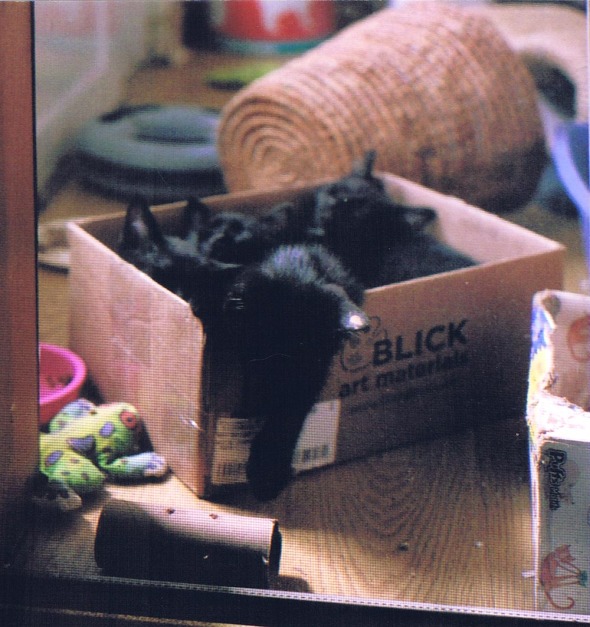
The Sleepy Siblings pack into the box for a nap.
There they are, the littles sleeping in a heap in a box, just like they do today. The event happens to be the day they had their first set of shots, and after tearing around the bathroom with the general excitement of visitors and each of them disappearing and reappearing one by one…well, they managed to get the bathroom like that several times a day. I have several photos of this because this first is a little unclear—these are on film, and the prints aren’t the best, though I have no means of scanning from the negatives at the moment.
The pattern you see in front of them all is really a window screen. The bathroom has a bifold door but I didn’t want to cut the kittens off from the rest of the house by leaving the door closed. I used two tall narrow screens from my old casement windows hinged to the doorframe and opening like shutters so that during the day the kittens could see onto the landing and interact with the rest of the house, and also be cooler since it was August and September. Mimi could easily jump the screens to get in and out so she had her breaks too.
Mr. Sunshine is hanging out of the box, here at the corner, and you can just see a light spot on his year which is his yellow paint. Giuseppe is behind him with a tiny bit of green paint visible, then Mewsette, then Jelly Bean. They are seven or eight weeks old here. In photos further down you’ll be able to see them better.
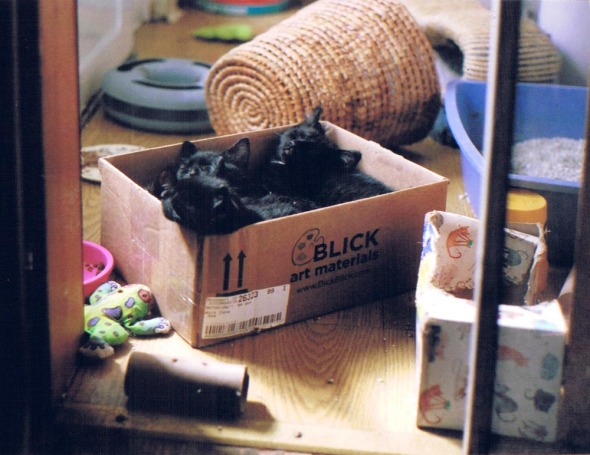
Their faces are a little more clear.
They were sleeping off their shots, so I opened the screen to see them more clearly. Lessons about photographing a bunch of black cats were just beginning as they are almost indistinguishable in the box. The little cardboard toilet paper roll and tissue box are full of toothmarks—I had forgotten how kitten chewed on everything! They had about a dozen toilet paper and paper towel rolls in there, and they and the tissue box were reduced to shreds in the time there.
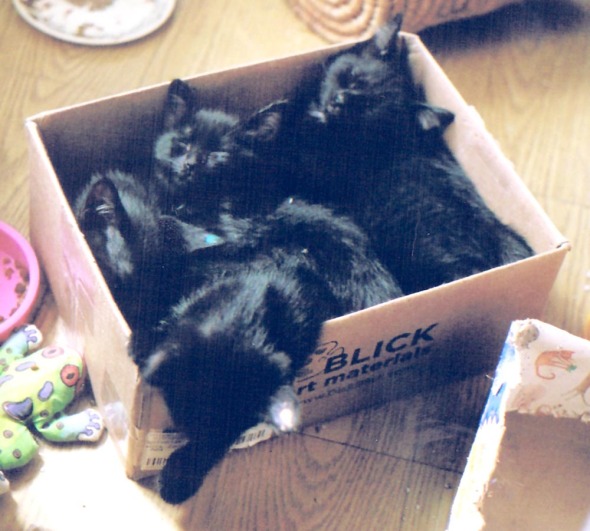
The view from above, too sweet.
This print wasn’t very well-printed, and when I lightened it it began to fall apart, but you can see their little faces in the box, Sunshine, Giuseppe, Mewsette and Jelly Bean, and you can see a bit of the white spot on his chest, and the white hairs in his ears that looked like big brushes until he grew into them.
I had always thought about one of the top two as a painting, just a silly colorful kittens’ playroom!
Reference this little heap with yesterday’s cuddle puddle on my desk.
______________________________
Unless I have linked the photo to something else, which is rare with daily photos, you can click the photo to see a larger version. I save them at 1000 pixels maximum dimension, and at that size the photos are nearly twice the dimension and you can see more detail in many of the photos I post. Please remember if you download or share, my name and the link back to the original photo should always appear with it.
To see more daily photos go to “Daily Images” in the menu and choose “All Photos” or any other category.
All images used on this site are copyrighted to Bernadette E. Kazmarski unless otherwise noted and may not be used without my written permission. Please ask if you are interested in purchasing one as a print, or to use in a print or internet publication.
CCPC Pet First Aid Classes for May through July
Posted: May 4, 2012 Filed under: animal welfare, cats, chartiers custom pet cremation, dog, events, karen sable, pet and animal information | Tags: cats, chartiers custom pet cremation, dogs, pet first aid, pet health care, pets 1 Comment
A successful bandage.
Since June 2011, Chartiers Custom Pet Cremation has sponsored pet first aid introductory and certification classes in Bridgeville and surrounding communities in the south and west of Pittsburgh, taught by Karen Sable of Pet Emergency Training, LLC. Although there is usually a charge for attending these classes, Chartiers Custom Pet Cremation offers these sessions free of charge in an attempt to offer families the skills they can use to help save the life of their pet.
Upcoming classes
Currently scheduled classes are listed below, but new opportunities arise all the time as individuals and communities express an interest in hosting a class. For ongoing dates and times visit the Pet First Aid Classes page on the CCPC website or call Deb Chebatoris at 412-220-7800.
The next certification class is June 2 in Bridgeville, most other classes listed are introductory classes. Read a post about the difference between the two classes and my post about the certification class I attended. See below for details of date, time and place.
You need to register for each session by calling Deb Chebatoris at 412-220-7800. Space is limited, and registrations are taken first come, first served.
INTRODUCTORY CLASSES
Sunday, May 20, 2012, Washington, PA
Washington Area Humane Society
1527 Route 136, Eighty Four, PA 15330
Introductory Class, 1:00 to 2:30 p.m.
Wednesday, May 23, 2012, Peters Township, PA
Peters Public Library
616 East McMurray Road McMurray, PA 15317
Introductory Class, 7:00 to 8:30 p.m.
CERTIFICATION CLASSES
Saturday, June 2, 2012, Bridgeville, PA
Bridgeville Public Library
505 McMillen Street, Bridgeville, PA 15017
Certification Class, 11:45 a.m. to 4:15 p.m.
Sunday, July 22, 2012, Bridgeville, PA
West Allegheny Community Library
8042 Steubenville Pike, Oakdale, PA 15071
Certification Class, 12:00 to 4:30 p.m.
NOTE: Deb Chebatoris is a personal friend as well as the person who receives my cats for cremation, and is also one of my customers for design and promotion; I try to be unbiased.
————————————
All images and text used on this site are copyrighted to Bernadette E. Kazmarski unless otherwise noted and may not be used in any way without my written permission. Please ask if you are interested in purchasing one as a print, or to use in a print or internet publication.
Daily Sketch: Fangs
Posted: May 3, 2012 Filed under: animal artwork, black cats, cats, daily sketch, giuseppe, ink, mimi | Tags: black cat, cat art, cat sketches, cats, ink sketch of cat sleeping 2 Comments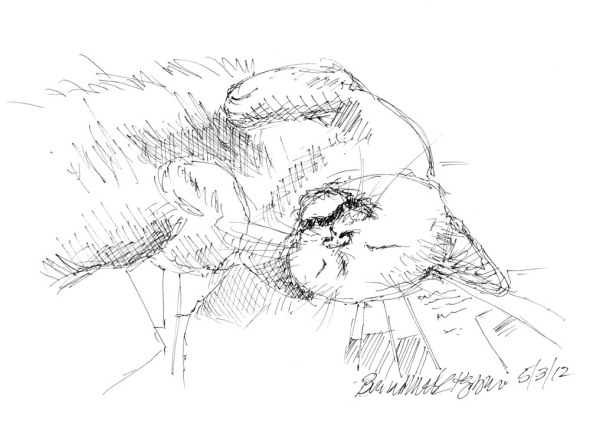
Sleeping With Fangs, ink © B.E. Kazmarski
There’s been a lot of this lately, lolling about on my desk. When Giuseppe turns his head upside down, his mouth falls open and I can see two little fangs. Vicious kitty. He fell deeply asleep so I had the chance to sketch him.
Not a difficult or detailed sketch, but just a note on drawing a subject in an orientation different from the way you are accustomed to seeing them. Even looking directly at him, my inner eye kept turning him right side up, and it was almost like yesterday when I was trying to draw around Mimi’s initial outline and it was confusing me.
This was done with a .35 felt-tip technical marker.
________________________
Click here to see other daily sketches, and for a gallery of the ones available for sale, visit my Etsy shop in the “Daily Sketches” section.
All images used on this site are copyrighted to Bernadette E. Kazmarski unless otherwise noted and may not be used without my written permission. Please ask if you are interested in purchasing one as a print, or to use in a print or internet publication.
Kelly in Forget-me-nots
Posted: May 3, 2012 Filed under: cat photographs, cats, daily photo, kelly, photographs, senior cats, spring, tortoiseshell cats | Tags: cat photographs, cat with flowers, cats, feline photographs, pet photography, photography, tortoiseshell cat 16 Comments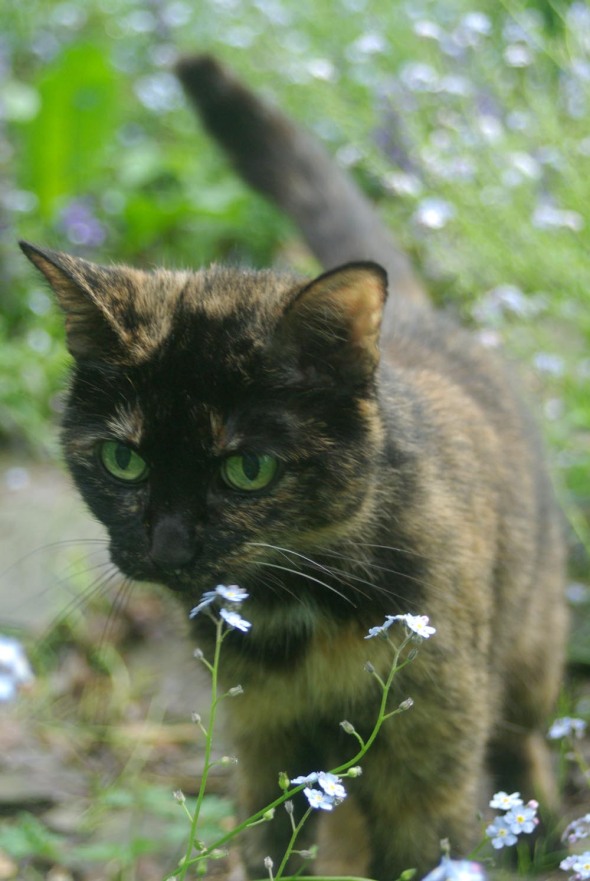
Kelly in forget-me-nots.
Kelly has been stepping out into the back yard with me now and then, even asking at the door to go out. She’s never shown any interest in the 15 years she’s been with me until this spring, and I can’t help but think she associates the outdoors, and the spring forget-me-nots, with Cookie, as I do. Kelly is now the lone senior cat, and she’s very lonely without an older kitty to cuddle with and protect her; she’s a little intimidated by the gregarious black cats. Observing what she does, I think she’s looking for and communing with Cookie, again, as I do.
This is a kind of an odd angle—I had my zoom lens as I’d been photographing details of forget-me-nots and buttercups together and the cranesbill geraniums and columbines with raindrops from last night’s storms. Kelly’s a little foreshortened, but it’s a good view of her face and those brilliant green eyes; even without the reflection of lush vegetation, Kelly’s eyes are like gems. It’s hard to believe she is 18 this year because she is still active, lithe and graceful, and because she was the youngest for 11 years I still think of her as the little one.
Read Kelly’s story in five parts: A Little Bit About Kelly.
________________________________
Unless I have linked the photo to something else, which is rare with daily photos, you can click the photo to see a larger version. I save them at 1000 pixels maximum dimension, and at that size the photos are nearly twice the dimension and you can see more detail in many of the photos I post. Please remember if you download or share, my name and the link back to the original photo should always appear with it.
To see more daily photos go to “Daily Images” in the menu and choose “All Photos” or any other category.
All images used on this site are copyrighted to Bernadette E. Kazmarski unless otherwise noted and may not be used without my written permission. Please ask if you are interested in purchasing one as a print, or to use in a print or internet publication.
And then I gave up work for the day…
Posted: May 3, 2012 Filed under: black cats, cat photographs, cats, daily photo, giuseppe, jelly bean, mewsette, mimi, mimi's children, mr. sunshine, photographs | Tags: black cats, cat photographs, cats, feline photographs, mimi's children, pet photography, photography 14 Comments
Maybe she’ll notice us now.
The above photo is from 2009, but I like to call it back up each year. Some things never change.
2011: Okay, okay, I admit I’ve been busy, but do you guys like to eat?! Then you’ll keep doing things like this as inspiration.
For now, enjoy somewhat over 50 pounds of black cat on one desk.
2009: They are always doing something unique, that whimsical quartet of siblings, but sometimes they have the right idea. I really was tired, my eyes were strained, I was losing focus at the end of a long day, and one by one the three boys piled up trying to get their point across (we need dinner, you need to stop working), hence the multiple nap. First Giuseppe front and center, paws draped on my keyboard, then Jelly Bean on the left and Mr. Sunshine on the right. Then Mewsette, the big sister, piled on top of all of them and began bathing them all in turn, causing things to start falling off my desk. Still, I could pile papers on top of them and keep working. When the paws and tails expanded onto my keyboard, I decided to take their advice and quit working for the day.
Below is a version from 2012, today in fact, and the only difference is that Mimi is part of the group on the far left so it isn’t quite 50 pounds of black cat, and the other three are Giuseppe, Mewsette and Mr. Sunshine, just continuing yesterday’s heat-induced laziness.
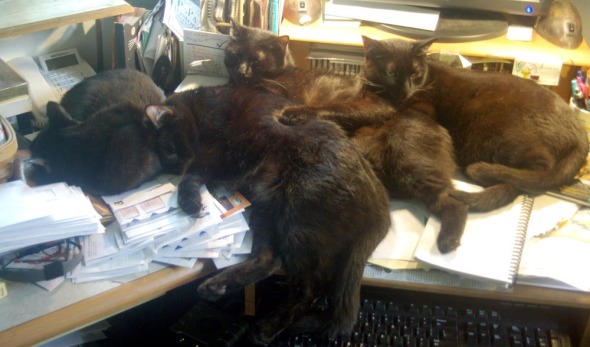
Four cats on my desk.
________________________________
Unless I have linked the photo to something else, which is rare with daily photos, you can click the photo to see a larger version. I save them at 1000 pixels maximum dimension, and at that size the photos are nearly twice the dimension and you can see more detail in many of the photos I post. Please remember if you download or share, my name and the link back to the original photo should always appear with it.
To see more daily photos go to “Daily Images” in the menu and choose “All Photos” or any other category.
All images used on this site are copyrighted to Bernadette E. Kazmarski unless otherwise noted and may not be used without my written permission. Please ask if you are interested in purchasing one as a print, or to use in a print or internet publication.
A Gift for all Moms and Dads
Posted: May 3, 2012 Filed under: animal artwork, cat artwork, cat painting, cats, commissioned portrait, dog, dog portrait, feline artwork, original artwork, pastel, pastel painting, pet portrait, portrait, watercolor | Tags: cat artwork, cat painting, commissioned portrait, pastel portraits, pet portrait, portrait, set of portraits, watercolor portraits 1 Comment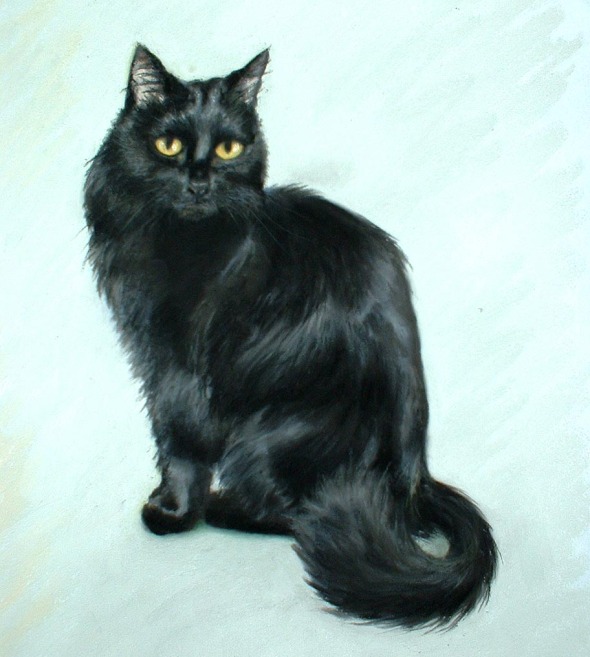
A Mother’s Day gift: Hobbes, pastel, 12″ x 15″, 2004 © B.E. Kazmarski
Did your parents pass on to you a love of animals? Did they decide one day you needed an animal companion of your own, starting you on a lifelong path of sharing your days with cats and dogs and birds and bunnies and ferrets and any other animal that came along?

Veronica’s Tulips, watercolor, 16″ x 23″, 2008 © B.E. Kazmarski
Thank those people who gave you this gift—and I’m loosely defining mother and father because sometimes the person who shared their love of animals with you was an aunt or uncle or grandparent, or even a neighbor who rescued cats or dogs. In everyone’s life is at least one special person who shared a love of animals, and in that person’s life there is often an animal companion who is or was very special to them. Read about Shadow, Casey and Ralph and a special Mother’s Day gift from 2006.
And thinking a little less conventionally, consider a piece of custom art that also includes an animal. For “Veronica’s Tulips”, right, this pet mom got the painting for herself, and wanted both flowers and, after a lifetime of rescued Schnauzers also wanted a Schnauzer in her painting, though not to represent any individual she had lived with. This was the very natural solution.
I’m offering 10% off the purchase of a portrait certificate or a commissioned portrait that is booked between now and Mother’s Day—and Father’s Day as well. Portraits take up to four weeks, especially with framing and then shipping, but we can work things out with certificates and portraits that are done some time in the next two months.
About Commissioned Portrait Gift Certificates

Sample Commissioned Portrait Certificate
The certificate itself is 8.5″ x 11″ and features a collage of portrait images with the recipient’s and giver’s names, printed on parchment cover stock. The whole thing is packaged in a pocket folder and includes a brochure, a letter from me to the recipient and several business cards.The certificate package can be easily mailed or wrapped as a gift and shipped directly to your recipient.
I can also make it downloadable if you’re in a hurry.
Portrait certificates are a minimum of $125.00 because that is the minimum cost of a portrait.
Certificates are good for up to one year after issue.
Mother’s Day Discounts in my Etsy Shop
Use MOTHERSPORTRAIT10 to receive 10% off the purchase of a portrait certificate or of the cost of a commissioned portrait (we will discuss the portrait and I will give you an estimate).
Use MOTHERSDAY10 to receive 10% off the purchase of Mother’s Day gifts, which may include a portrait certificate or of the cost of a commissioned portrait.
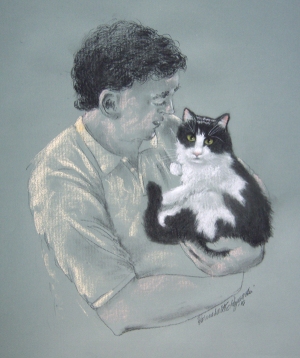
Fred and Simba © B.E. Kazmarski
Father’s Day Discounts in my Etsy Shop
Think guys aren’t cat daddies? I’ll be telling more about Fred and Simba, at left, in a few weeks, but trust me they aren’t the only cat and guy combinations around.
Use FATHERSPORTRAIT10 to receive 10% off the purchase of a portrait certificate or of the cost of a commissioned portrait (we will discuss the portrait and I will give you an estimate).
Use FATHERSDAY10 to receive 10% off the purchase of Mother’s Day gifts, which may include a portrait certificate or of the cost of a commissioned portrait.
Take a look at other portraits and read other stories
Read articles here on The Creative Cat featuring current and past commissioned portraits.
Read about how I create commissioned portraits.
Purchase a gift certificate for a commissioned portrait.
Visit my website to see portraits of my cats, commissioned cats, commissioned dogs, people and a demonstration of how I put a portrait together from photos.
Commissioned Cat Portraits |
Commissioned Dog Portraits |
All images used on this site are copyrighted to Bernadette E. Kazmarski unless otherwise noted and may not be used without my written permission. Please ask if you are interested in purchasing one as a print, or to use in a print or internet publication.
Daily Sketch: Relaxing
Posted: May 2, 2012 Filed under: animal artwork, black cats, cats, charcoal, daily sketch, giuseppe, mimi | Tags: black cat, cat art, cat outline, cat sketches, cats, charcoal sketch of two cats Leave a comment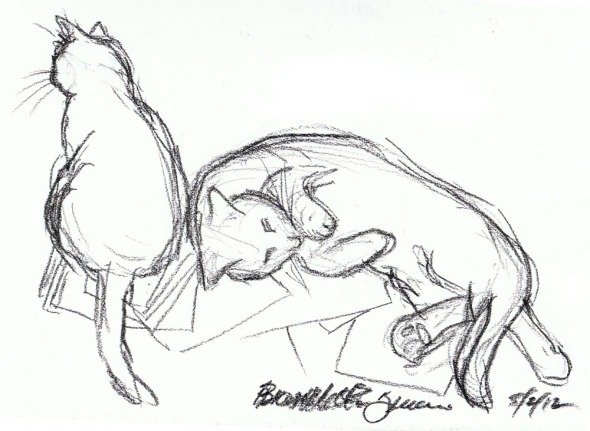
Relaxing, charcoal pencil © B.E. Kazmarski
I’m glad someone got some work done around here today because my cats were all totally useless. So the temperature was a humid 82 degrees in mid-afternoon. I wasn’t lying around like a dishrag! But I did have two or more cats on my desk all day, and still do at this very moment. I guess they wanted me to see how miserable they were.
Mimi sits up for a brief interlude of awakeness in an entire day of sleeping on top of the same pile of mail in nearly the same position all day. For most of the time, Giuseppe used her as a pillow, at which point you couldn’t see too much of her. Giuseppe takes up enough room for two cats and tries to spread himself as far as he can go.
Even in their resting state, unless they are in a deep sleep, they move constantly. Most sketches take me less than five minutes as my goal is to challenge my observation skills and hand-eye coordination and to keep from getting mired down in details. When I sketch them as outlined figures, I rough in their approximate outline, then go from one section to another with harder lines to define the outline. When I have more figures I rough in all of them then define their heads and other features as quickly as possible.
Paws and tails and heads may move in the meantime but the light rough outline keeps me in line and unless they get up and move completely before I have enough detail I’m fine with filling in quickly from that extremely short-term memory that holds an image in my mind clearly, but only for a few minutes before it begins to fade. In this case Mimi had been initially washing her face and her head was curved down much farther and at a different angle. She sat up, so I worked on other areas of the sketch waiting to see if she would go back to washing her face. In this case the short-term memory was holding too much, and there are times when I will put the sketch aside but keep an eye on the cat in question, and even hours later catch them in the same activity and finish the section I need. She never did go back to that position, so I drew her upright position instead.
If I’ve drawn in guidelines or even begun to firm up an area and they move, I leave the lines there, and I’ll try to work them into the finished sketch. I don’t erase anything unless, when I’m done, something in the finished sketch looks too confusing to let it go, and then I’ll try my best to lighten the lines or remove them. In this case something was confusing to me while I was drawing and I had to remove prior lines. Where Mimi had been leaning forward washing her face as I described above, my prior lines kept me thinking she was crouching and I was tending to draw what I was thinking instead of what was there, that three-quarter back posture, the two alert ears, her attention turned away. I had to erase that original outline as best as I could in order to go on.
All that for this simple little sketch!
________________________
Click here to see other daily sketches, and for a gallery of the ones available for sale, visit my Etsy shop in the “Daily Sketches” section.
All images used on this site are copyrighted to Bernadette E. Kazmarski unless otherwise noted and may not be used without my written permission. Please ask if you are interested in purchasing one as a print, or to use in a print or internet publication.





 The Creative Cat